Straightness, crookedness and the horse’s nature
Jan 26, 2026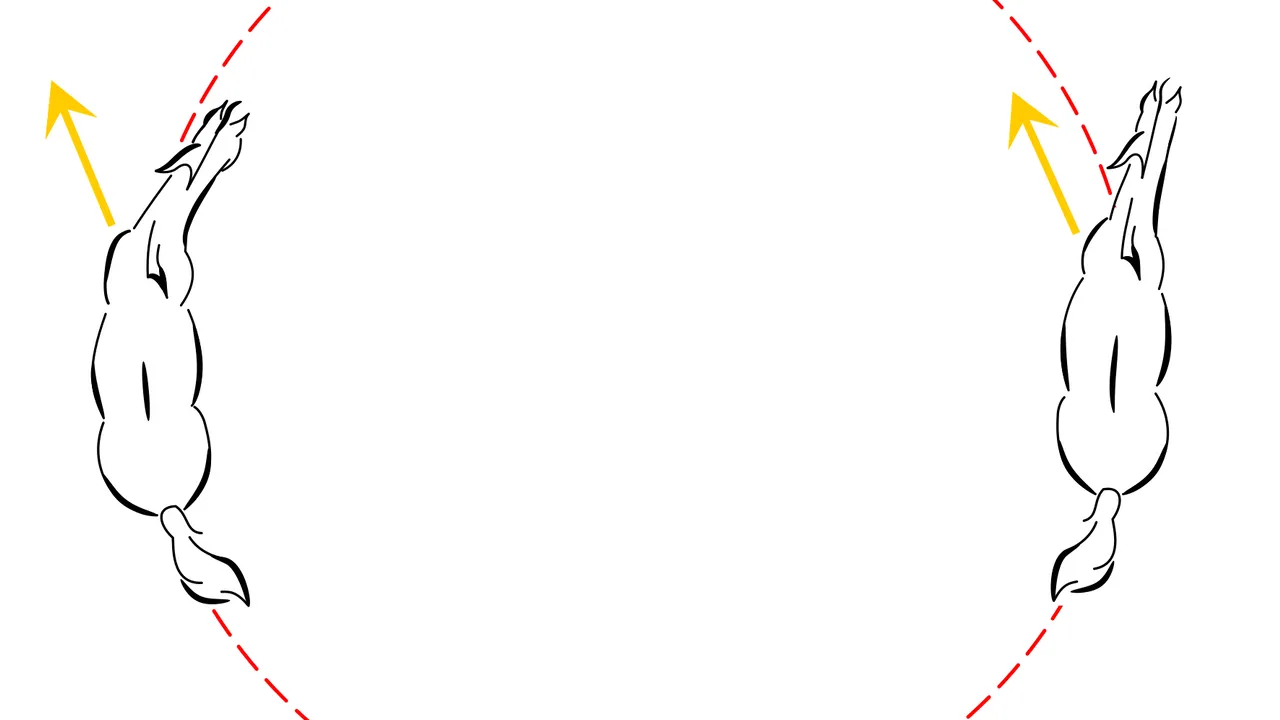
Every horse is crooked.
Some just a little more than others.
Many riding-related challenges are connected to one of the seven crookedness patterns. Your training should therefore be aimed at reducing this crookedness. This is what we call straightening.
Through straightening, you work on improving your horse’s balance and reducing the inequality caused by crookedness. When this is not taken into account sufficiently in training, the crookedness can increase. This can lead to serious problems. Depending on the type of horse, this may result in physical issues or behavioural problems.
How crookedness shows up first
When a horse is crooked, this is always noticeable first in riding-related challenges.
For example:
-
Difficulty turning to the left or right
-
Heavier contact on one rein or resistance on the other
-
The rider collapsing to the outside
-
A saddle that consistently lies crooked
-
Heavy contact
-
Speeding up or slowing down in turns
All of these can be signs of crookedness.
If these challenges are not approached from the perspective of straightening, the crookedness will increase. The horse begins to brace, becoming more crooked or stiffer. If this process continues without addressing the core issue, the next stage follows.
For one horse this means physical complaints or injuries.
For another, it results in behavioural problems such as refusing, rearing or bucking.
Which type of horse develops physical issues?
When we look at the five elements and their corresponding character traits, we can roughly divide horses as follows:
The wood horse
The wood horse is a fighter and enjoys taking on challenges. He is extraverted and very clear in his opinions. This type of horse will go through fire for you, but will also express himself clearly when something is wrong.
When this horse runs into problems due to crookedness, he will express this outwardly and resist. This may show as behavioural issues such as rearing, refusing or bucking.
The fire horse
The fire horse is also outwardly expressive. This horse enjoys attention and is full of energy and enthusiasm. When crookedness creates problems for this type, he too may respond with resistance, often explosively and very clearly directed outward.
The earth horse
The earth horse, on the other hand, is much more even-tempered. An earth-type horse or pony is economical with his energy. He is more likely to slow down, become dull, or stop altogether.
When corrected, he may continue for a while, but if the crookedness is not addressed, this type runs a high risk of developing physical problems. Patiently and quietly, he carries the discomfort—until his body can no longer cope.
The metal horse
The metal horse is a no-nonsense type. He enjoys working. Give him a task and he will perform it. This is not an outwardly expressive horse. His energy is steady, and when he runs into problems, he retreats inward.
This type of horse also has an increased risk of physical injuries if crookedness is not addressed in time.
The water horse
The water horse is naturally more anxious. Every horse is a flight animal, but the water type even more so. When crookedness creates problems, this horse may flee into speed or become very spooky and fearful.
In conclusion
For all types of horses, the process starts with riding-related challenges.
As a rider, be alert to these signals and address the cause of your challenges—whether on the lunge line or under saddle—by working on straightness at the core.
This prevents problems from escalating and becoming physically visible (such as shoulder lameness, navicular issues, tendon injuries, etc.) or turning into behavioural problems as a cry for help when the body gets stuck.
Stay connected with news and updates!
Join our mailing list to receive the latest news and updates from our team.
Don't worry, your information will not be shared.
We hate SPAM. We will never sell your information, for any reason.